Why use a tool that does only one job when you can use a plant that masters ten? Stop relying on single-purpose chemicals that only mask one symptom. This one root doesn’t just stop the burn; it heals the lining, feeds your gut, and supports your whole respiratory tract.
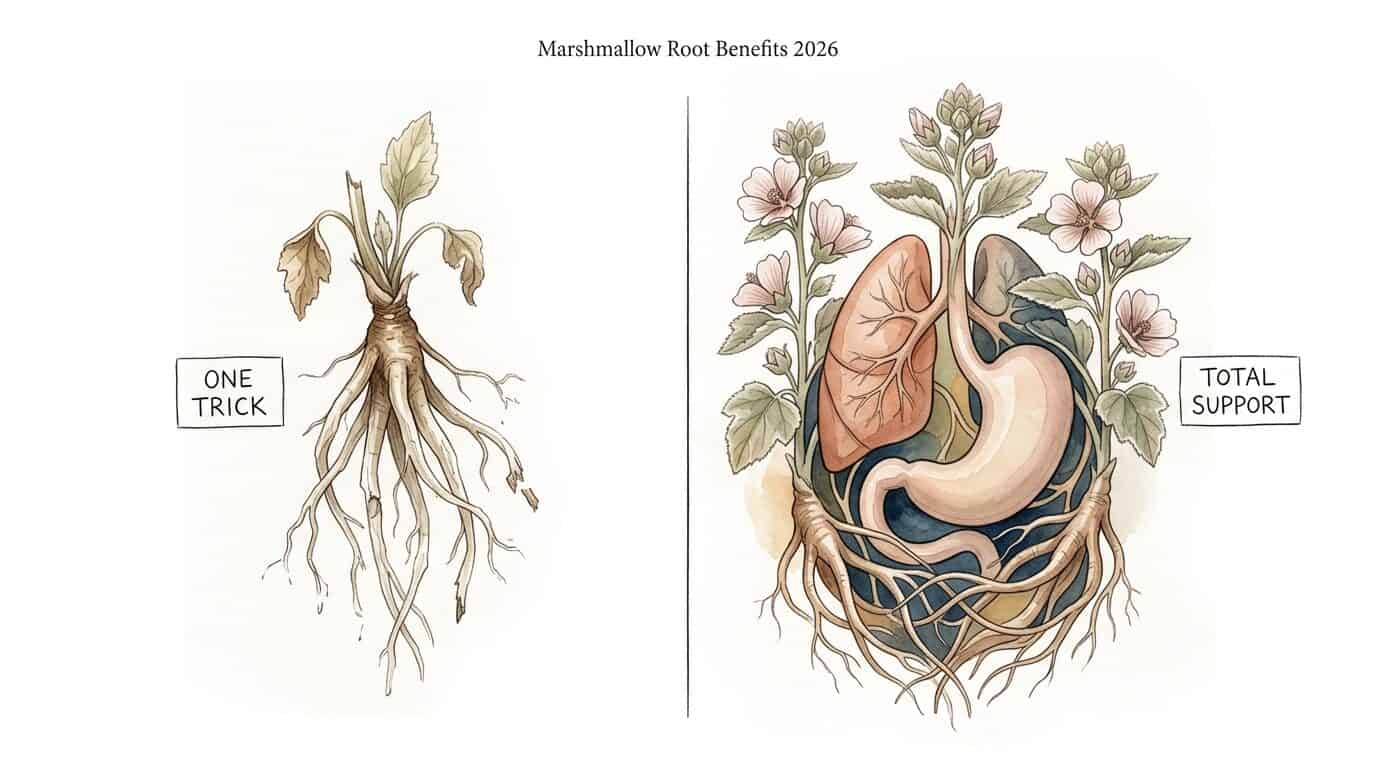
Our ancestors didn’t have the luxury of a different pill for every ache. They looked for the polymaths of the plant world—botanicals that provided a broad spectrum of relief with a single preparation. Marshmallow root is the undisputed champion of this category. It is a soft, cooling, and resilient presence in the garden and the apothecary.
Whether you are dealing with a “fire in the belly” from acid reflux or a “sandpaper throat” from a dry winter wind, this root offers a solution that modern synthetic compounds often struggle to replicate. It doesn’t just suppress; it coats, protects, and restores.
Marshmallow Root Benefits 2026
Marshmallow root, known scientifically as Althaea officinalis, is a perennial herb that has been a staple in human medicine for over two millennia. While most people today associate the word “marshmallow” with the sugary white puffs roasted over a campfire, the original confection was actually a medicinal treat made from this plant’s mucilaginous roots.
The plant itself is a member of the Malvaceae family, making it a close cousin to okra and hibiscus. In the world of herbalism, we classify it as a “demulcent.” This means it is rich in mucilage—a thick, gluey substance that plants produce to store water and food. When this mucilage comes into contact with human mucous membranes, it creates a physical, protective barrier.
In the context of 2026, where we are seeing a resurgence in “root-cause” wellness, marshmallow root stands out because it addresses the integrity of the body’s internal borders. From the lining of the stomach to the delicate tissues of the lungs, this plant acts as a liquid bandage. It is used in real-world situations ranging from recovery after a heavy course of antibiotics to soothing the skin of those working in harsh, drying environments.
The magic of the root lies in its polysaccharides. These complex sugar chains are not easily broken down by our digestive enzymes, allowing the mucilage to travel further down the digestive tract than many other soothing agents. This makes it a primary tool for those dealing with “leaky gut” or general intestinal permeability.
How It Works: The Science of Slime
Understanding marshmallow root requires understanding mucilage. If you have ever sliced okra or soaked chia seeds, you have seen mucilage in action. In Althaea officinalis, the root contains up to 25% of this thick substance.
When you ingest marshmallow root, usually in the form of a cold infusion or a powder, the mucilage does not just disappear. It adheres to the mucous membranes. This is a purely physical action rather than a systemic chemical change. By coating the esophagus, the stomach, and the intestines, it prevents stomach acid or irritating food particles from making direct contact with inflamed tissue.
Underneath this protective film, the body is given a “timeout.” Inflammation can subside because the constant irritation is paused. This is why it is so effective for “the burn.” It isn’t neutralizing acid like a chalky antacid; it is shielding the tissue so the acid can’t bite.
In the respiratory system, the mechanism is slightly different but equally effective. While the mucilage doesn’t physically travel into the lungs, it triggers a “reflex action.” The nerves in the gut are connected to the nerves in the lungs via the vagus nerve. By soothing the gut, the body sends a signal to the respiratory tract to reduce the cough reflex and increase the production of the body’s own fluid, thinning out stubborn mucus.
The Primary Benefits and Advantages
The versatility of marshmallow root makes it a cornerstone of any serious home apothecary. Its advantages stem from its unique ability to be both gentle and incredibly effective at the same time.
Digestive Restoration: For anyone dealing with GERD, gastritis, or peptic ulcers, marshmallow root is a game changer. It provides immediate relief from the physical pain of irritation while the polysaccharides work to support the underlying health of the gut wall. It is also a mild prebiotic, meaning it feeds the “good” bacteria in your microbiome.
Respiratory Relief: It is the premier remedy for a dry, non-productive cough. When your throat feels like it’s been scraped with wire, marshmallow root provides a cooling lubrication that stops the tickle and allows you to rest. It is particularly useful for the “lingering cough” that often follows a viral infection.
Urinary Tract Support: Because the mucilage is partially excreted through the urine, it can soothe the lining of the urinary tract. This makes it a common supportive herb for those dealing with the discomfort of UTIs or interstitial cystitis. It helps “grease the wheels,” making urination less painful during times of inflammation.
Topical Healing: Do not overlook its use on the skin. A poultice made from the powdered root is exceptional for drawing out heat from a burn, soothing the itch of eczema, or helping a stubborn splinter work its way to the surface. It hydrates the skin at a deep level, providing a reservoir of moisture that synthetic lotions often lack.
Challenges and Common Mistakes
The most frequent mistake people make with marshmallow root is treating it like every other herb. If you throw marshmallow root into a pot of boiling water and steep it like a standard tea, you are wasting your time and your money.
High heat “cooks” the mucilage. While you will still get some of the plant’s flavonoids and minerals, the thick, soothing polysaccharides will break down. To get the medicinal “slime” that does the heavy lifting, you must use a cold infusion. This involves soaking the dried root in room-temperature or cold water for several hours—usually overnight.
Another common pitfall is the “one-and-done” mentality. Because marshmallow root works physically, it needs to be used consistently. If you have chronic gut irritation, drinking one cup of marshmallow tea once a week won’t do much. You need to provide that protective coating consistently throughout the day until the underlying tissue has had time to repair itself.
Finally, people often mistake marshmallow root for a “cure-all” that works instantly. While the cooling sensation is immediate, the actual healing of a damaged gut lining or a chronic skin condition takes weeks of dedicated use. Patience is a requirement when working with this root.
Limitations: When This May Not Be Ideal
Despite its safety profile, marshmallow root is not for everyone in every situation. The very quality that makes it effective—its ability to coat surfaces—can be a drawback if you are taking other medications.
Because the mucilage creates a barrier in the gut, it can slow down or reduce the absorption of oral medications. If you take a critical pharmaceutical, you should wait at least two hours after your dose before consuming marshmallow root. Failure to do this could mean your medication doesn’t reach the blood levels required to be effective.
In terms of environmental limitations, the plant prefers damp, boggy soil (hence the name “marsh” mallow). If you are trying to grow it in a desert environment without significant irrigation, it will struggle. The roots will be small, woody, and low in mucilage.
There is also a concern for those with blood sugar issues. While not a “sugar” in the way table sugar is, the polysaccharides can theoretically affect blood glucose levels if consumed in massive quantities. Diabetics should monitor their levels when starting a new, heavy regimen of the root. Lastly, it is generally advised to stop use two weeks before any scheduled surgery, as it may interfere with blood sugar control during and after the procedure.
The Comparison: Marshmallow Root vs. Slippery Elm
When it comes to demulcent herbs, the two heavyweights are Marshmallow Root and Slippery Elm. Both provide exceptional mucilage, but they are used differently based on ethics and geography.
| Feature | Marshmallow Root | Slippery Elm |
|---|---|---|
| Source | The root of a perennial herb. | The inner bark of a tree. |
| Sustainability | Very high; easy to grow and harvest. | Lower; trees are threatened by Dutch Elm disease. |
| Prep Method | Best as a cold infusion. | Works well in warm water or as a gruel. |
| Best Use | Lower GI, Urinary, and Respiratory. | Upper GI, sore throats, and nutritional support. |
| Cost | Generally very affordable. | Increasingly expensive due to scarcity. |
For the conscious practitioner, marshmallow root is often the better choice. Because you can harvest the root and the plant continues to grow or can be easily replanted from seed, it is a much more sustainable option than stripping bark from a tree that may take decades to mature.
Practical Tips and Best Practices
To get the most out of your marshmallow root, follow these field-tested methods. These tips will help you maximize the mucilage content and ensure you are getting the healing benefits you expect.
- The Overnight Cold Infusion: Place 1/4 cup of dried, shredded marshmallow root in a quart-sized mason jar. Fill the jar with room-temperature filtered water. Let it sit on the counter or in the fridge for 4 to 8 hours. The water will become thick and slightly amber-colored. Strain the root out and drink the liquid throughout the day.
- The “Slurry” for Acute Relief: If you have an immediate bout of heartburn, take a teaspoon of marshmallow root powder and mix it with just enough water to make a paste, then add a bit more water to make it drinkable. Gulp it down. It acts like a liquid shield almost instantly.
- Growing Your Own: If you have a damp spot in your garden, plant marshmallow. It grows up to five feet tall and has beautiful, pale pink flowers. Harvest the roots in the fall of the second or third year for maximum potency. Scrub them clean, slice them thinly, and dry them immediately to prevent mold.
- Check the Quality: Good marshmallow root should be white to creamy-beige. If the root looks dark brown or gray, it is old or was dried improperly. It should also have a faint, sweet, earthy smell, reminiscent of a dusty meadow.
Advanced Considerations for Practitioners
For those looking to deepen their work with marshmallow root, consider its role as a “synergy herb.” Because it coats the gut and slows transit time slightly, it can be used to hold other medicinal herbs in contact with the intestinal wall for longer periods.
Combining marshmallow root with Calendula and Plantain creates the ultimate “leaky gut” protocol. The marshmallow provides the shield, while the calendula moves the lymph and the plantain knits the tissue back together.
From a prebiotic perspective, marshmallow root’s polysaccharides are fermented by the bacteria in the distal part of the colon. This produces short-chain fatty acids (SCFAs) like butyrate, which are the primary fuel for the cells lining your colon. This means marshmallow root isn’t just a band-aid; it’s a long-term fuel source for a healthy gut barrier.
In skin care, a cold-infused marshmallow root “gel” can be used as a base for facial serums. It provides a natural alternative to hyaluronic acid, offering a plumping effect that hydrates without the need for synthetic preservatives. Serious practitioners also use it as a “de-frizzing” agent in natural hair care, as the mucilage smooths the hair cuticle effectively.
Example Scenario: Taming the Winter Cough
Imagine it’s February. The air is bone-dry, the woodstove has been cranking for three months, and you’ve developed a “barking” cough. There’s no congestion, no phlegm—just a constant, irritating tickle that keeps you awake all night.
A standard cough syrup might dull the brain’s cough center, but the irritation remains. Instead, you prepare a quart of marshmallow cold infusion. You add a small slice of fresh ginger for circulation and a teaspoon of raw honey.
By sipping this throughout the evening, you are physically lubricating the tissues that the dry air has parched. The “barking” softens into a quiet hum. By the second day, the reflex has calmed, and the tissues have regained their moisture. You aren’t just suppressing a symptom; you are changing the environment that allowed the symptom to exist.
Final Thoughts
Marshmallow root is a testament to the idea that some of the most powerful tools in our health arsenal are also the gentlest. It doesn’t force the body into submission; it provides the protection and hydration the body needs to heal itself. In a world of aggressive interventions, there is something profoundly wise about choosing a root that simply offers a cool, protective embrace to our internal systems.
As you begin to integrate this plant into your life, start simply. Master the cold infusion. Notice how your body responds to the cooling properties of the mucilage. Whether you are stocking a survival kit or just looking to soothe a sensitive stomach, marshmallow root is a reliable, resilient companion.
Experiment with it. Use it as a poultice, a tea, or a prebiotic powder. The more you work with it, the more you will realize that this one root really does master ten different jobs. It is a foundational piece of botanical wisdom that belongs in every home.