Your esophagus has no protective lining against acid; at night, you are either wide open to damage or strategically sheltered by physics. Stop leaving your throat exposed to a chemical burn every night. By 2026, we’ve mastered the ‘left-side incline’ that uses gravity to shelter your most delicate tissues from rogue acid.
Sleeping is not just a period of rest; it is a tactical positioning of your internal organs. When you lie down, you lose the natural verticality that keeps stomach acid where it belongs. For those of us living with chronic reflux or GERD, the night is a battlefield where the terrain is your own digestive tract. Understanding how to manipulate your body’s orientation is the difference between waking up refreshed and waking up with a scorched throat and a raspy voice.
Modern science has finally caught up with what our ancestors likely felt in their bones: the architecture of the human stomach is asymmetrical. Because the stomach sits toward the left side of the abdomen, your choice of side determines whether the entrance to your esophagus is submerged in acid or perched safely above the waterline. This isn’t about comfort alone; it is about engineering a night of safety for your internal systems.
Focusing on these mechanical realities allows us to stop guessing and start protecting. We are looking at the body as a system of pipes and reservoirs. If the reservoir leaks, you don’t just mop up the mess; you tilt the pipe so the leak cannot reach the sensitive parts. This guide will show you exactly how to fortify your sleep environment for the long haul.
Best Sleep Positions For Heartburn 2026
The gold standard for managing nighttime acidity in 2026 remains the left-side incline. This position is a marriage of two distinct physical strategies: lateral orientation and gravitational elevation. To understand why this works, you must visualize the stomach as a curved flask. The opening to the esophagus—the lower esophageal sphincter (LES)—is located on the right side of the stomach’s upper curve.
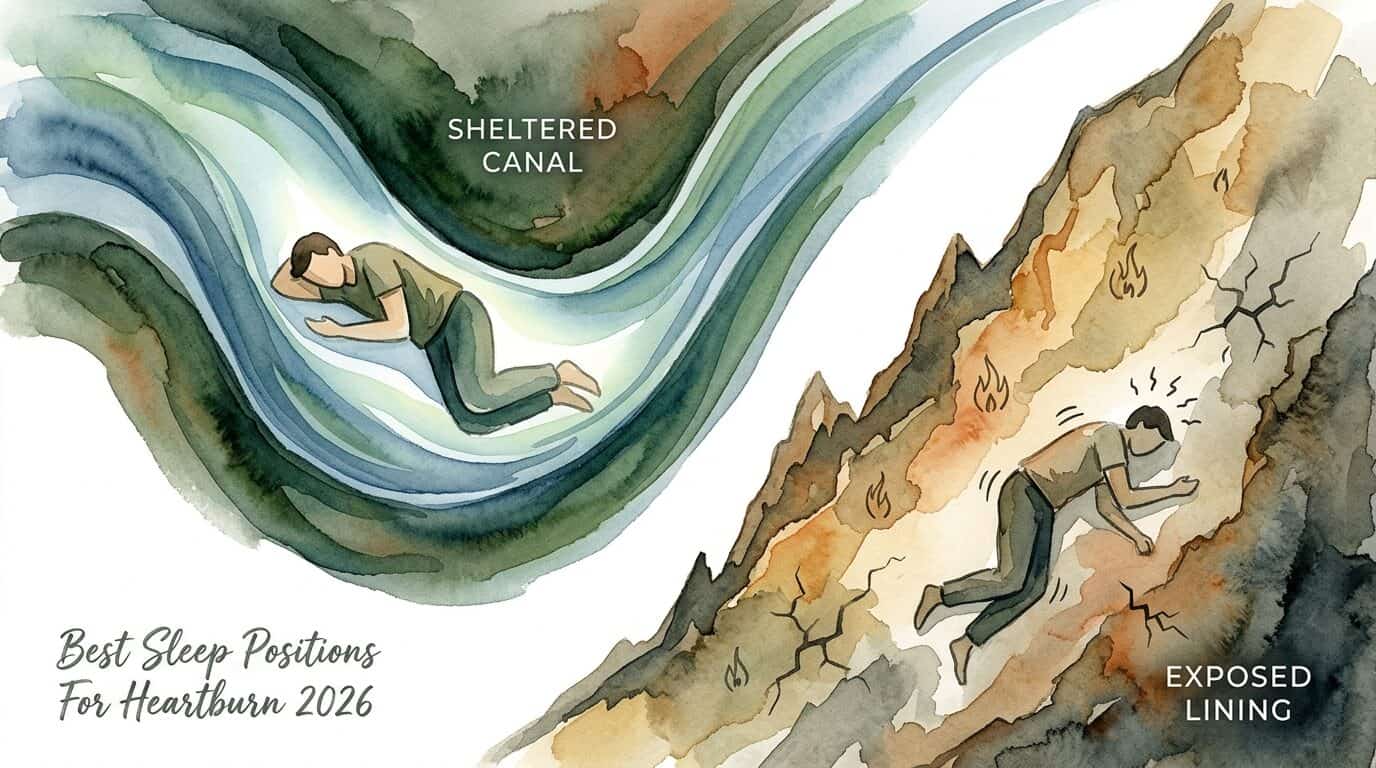
When you sleep on your left side, the stomach sits lower than the esophagus. Gravity keeps the pool of gastric acid at the bottom of the “J” shape of the stomach. In this configuration, even if the LES relaxes or fails to close completely, the acid must fight an uphill battle to reach the esophagus. This creates what we call the sheltered canal, where the delicate lining of your throat is kept away from the corrosive contents of your digestive system.
Conversely, sleeping on your right side places the stomach above the esophagus. This is the “exposed lining” scenario. In this position, the stomach acid pools directly against the LES. Any minor leak or pressure from the abdomen causes acid to flow freely into the esophagus, leading to the familiar burn and long-term tissue damage known as Barrett’s esophagus. The 2026 approach treats this positioning with the same seriousness as a mechanic treats a fuel leak.
How the Left-Side Incline Works
Achieving the perfect defensive position requires more than just rolling over. You must understand the mechanics of the incline and the lateral shift to get the most protection. The goal is to use the natural “J” shape of your stomach to your advantage while using an incline to ensure that even the smallest splashes of acid are pulled back down by gravity.
Step one involves the incline itself. This isn’t about stacking soft pillows under your head, which only bends your neck and increases abdominal pressure. Instead, the entire upper torso must be elevated at an angle of 15 to 20 degrees. This keeps the esophagus consistently higher than the stomach, regardless of which way you turn, though the left side remains the primary goal.
The second step is the lateral lock. When you settle onto your left side, your stomach’s greater curvature becomes the lowest point in your torso. This creates a large reservoir for acid to settle into, far away from the esophageal opening. Think of it like a boat hull; if you tilt the hull to the left, the bilge water collects on the left side, keeping the electrical components on the right side dry.
Finally, consider the role of the lower esophageal sphincter (LES). This muscle acts as a gatekeeper. When you are horizontal, the pressure of the stomach contents can force this gate open. By using the left-side incline, you reduce the hydrostatic pressure against this valve, allowing it to stay closed with less effort from your body.
Benefits of Strategic Sleep Positioning
The primary benefit of mastering your sleep position is the immediate cessation of nighttime tissue damage. Stomach acid is powerful enough to dissolve metal; your esophagus, unlike your stomach, has no mucous barrier to protect it. By shielding this tissue, you allow existing inflammation to heal and prevent the formation of scar tissue or cancerous cells over decades of life.
Another measurable advantage is the improvement in sleep quality. Reflux doesn’t always wake you up with a burning sensation; often, it manifests as “silent reflux,” causing micro-awakenings that ruin your REM cycles. When you stabilize your internal chemistry through positioning, you often find that you wake up feeling more rested, without the “fog” associated with disrupted sleep.
There is also a significant reduction in morning respiratory issues. Acid that reaches the throat can be inhaled into the lungs in microscopic amounts, leading to chronic coughing, wheezing, or even pneumonia. Positioning yourself correctly ensures that your airways remain clear and your lungs are not subjected to acidic vapor throughout the night.
Challenges and Common Mistakes
The most frequent error is the “Pillow Stack Trap.” Many people try to treat heartburn by putting three or four pillows under their head. This is a mistake because it creates a “C” shape in the body, which actually puts more pressure on the stomach and forces acid upward. It also strains the neck and shoulders, leading to chronic pain that eventually forces the sleeper back into a flat position.
Another challenge is the “Right-Side Roll.” Most humans change positions multiple times per night. If you start on your left but spend six hours on your right, you are still exposing your lining to damage. Training the body to stay on the left requires physical barriers, such as a long body pillow placed behind the back to prevent rolling over during deep sleep.
Food timing is also a common pitfall that positioning can only partially fix. If you eat a heavy, fatty meal and then immediately go to bed, even the best left-side incline will struggle to manage the volume of acid produced. Gravity is a powerful tool, but it works best when the stomach isn’t overflowing. A “clearance period” of at least three hours before bed is essential for the physics of positioning to be effective.
Limitations and Constraints
While the left-side incline is highly effective, it is not a universal cure-all. People with certain musculoskeletal issues, such as severe hip bursitis or shoulder impingement, may find it difficult to stay on one side for the entire night. In these cases, the “pioneer-grit” approach requires finding a middle ground, such as using a more aggressive incline while remaining on the back.
Environmental factors also play a role. A soft, sagging mattress will defeat even the best wedge pillow by allowing the hips to sink and the torso to bend awkwardly. You need a firm foundation to maintain the proper angles. If your bed is old or poorly supported, the mechanical advantage of the left-side incline is neutralized by the poor geometry of the sleeping surface.
Finally, there are physiological trade-offs. Some individuals find that exclusive left-side sleeping can lead to pressure points on the shoulder or ear. It requires a disciplined approach to padding and support to ensure that one problem (heartburn) isn’t simply traded for another (joint pain). Consistency is more important than perfection, but the goal should always be to maximize time spent in the “sheltered” position.
Comparison: Exposed Lining vs. Sheltered Canal
Understanding the difference between a dangerous sleep setup and a protective one is easier when you see the factors laid out side-by-side. The following table compares the “Exposed Lining” (flat or right-side) versus the “Sheltered Canal” (left-side incline).
| Factor | Exposed Lining (Flat/Right) | Sheltered Canal (Left Incline) |
|---|---|---|
| Acid Location | Pools against the esophageal valve. | Collects in the stomach’s greater curve. |
| Gravity’s Role | Pushes acid into the throat. | Pulls acid away from the throat. |
| Tissue Impact | Chronic chemical burns and inflammation. | Allows lining to rest and recover. |
| Morning Symptoms | Sore throat, cough, bitter taste. | Clear throat, fresh breath, no pain. |
| Complexity | Low (default behavior). | Moderate (requires gear/training). |
Practical Tips for Immediate Improvement
If you want to start protecting your esophagus tonight, begin by auditing your current sleep gear. A standard pillow is not a medical device. Invest in a high-density foam wedge pillow that is at least 24 inches long. This length ensures that the incline starts at your lower back, not your neck, maintaining a straight spine while elevating the chest.
Use the “wall technique” if you are a restless sleeper. Place your bed against a wall and sleep with your left side facing the room. This gives you a solid surface to lean your back against, making it harder to roll onto your right side. If a wall isn’t an option, a heavy “husband pillow” or a pregnancy pillow can provide the lateral resistance needed to keep you locked in place.
Monitor your “first-hour” comfort. The most critical time for reflux is the first hour after you fall asleep, as your body’s systems slow down and the LES relaxes. Ensure your incline is set before you even get into bed. Don’t try to adjust it while you are groggy; set the stage for success while you are still fully awake and alert.
Finally, consider your pajamas. Loose-fitting clothing is essential. Anything that constricts the waist—like tight elastic bands or belts—increases intra-abdominal pressure. This pressure acts like a hand squeezing a balloon, forcing stomach acid upward regardless of your position. Wear loose, breathable fabrics that allow your abdomen to expand and contract naturally as you breathe.
Advanced Considerations for Serious Practitioners
For those who have struggled with GERD for years, simple positioning might need to be augmented with deeper lifestyle adjustments. One such consideration is the “gastric emptying rate.” Certain foods, particularly high-fat proteins and fibers, stay in the stomach longer. If you are using the left-side incline but still feel pressure, you may need to move your largest meal to lunchtime and keep dinner exceptionally light and liquid-based.
Another advanced tactic involves the use of “Gaviscon Advance” or similar alginate-based rafts. When taken before bed, these medications create a physical foam barrier that sits on top of the stomach acid. When combined with the left-side incline, this creates a double-layered defense: gravity pulls the liquid down, and the alginate raft blocks any rogue splashes that might occur if you shift in your sleep.
Serious practitioners also look at their breathing patterns. Diaphragmatic breathing strengthens the diaphragm muscle, which surrounds the LES. A stronger diaphragm acts like a secondary clamp on the esophagus. Practicing deep, belly-focused breathing while lying on your left side before falling asleep can help “reset” the tension in this area, providing better closure throughout the night.
Finally, consider the impact of hydration. Drinking a large glass of water right before bed can distend the stomach and neutralize the benefits of your incline. If you must hydrate, do so in small sips and try to finish your significant water intake at least an hour before you lay down. A full stomach is a heavy stomach, and weight is the enemy of gravitational protection.
Examples and Scenarios
Consider the case of a 45-year-old office worker who suffers from chronic “morning hoarseness.” They traditionally sleep on their back with two pillows. Despite taking acid blockers, the hoarseness persists. By switching to a 7-inch wedge pillow and training themselves to sleep on their left side using a body pillow for support, they eliminate the “exposed lining” scenario. Within two weeks, the hoarseness disappears because the vocal cords are no longer being bathed in acidic vapor for eight hours a night.
In another scenario, a night-shift worker has to sleep during the day when the body’s digestion is naturally more active. They often eat a large meal at 7:00 AM before going to bed at 8:00 AM. For this person, the left-side incline is not just a preference; it is a necessity. Because their stomach is actively processing a meal while they sleep, the risk of reflux is tripled. By using a mechanical bed frame to lift the head of the bed by six inches and staying strictly on the left side, they prevent the “chemical burn” that previously ruined their sleep and productivity.
Finally, think of the athlete who consumes high-calorie shakes before bed to maintain muscle mass. The liquid nature of these shakes makes them highly prone to reflux. By implementing a “sheltered canal” strategy, they can consume the necessary nutrients without damaging their esophagus. They use a specialized wedge with a cutout for the arm, allowing them to stay on their left side comfortably without developing shoulder pain, proving that even with high stomach volume, physics can still protect the body.
Final Thoughts
Protecting your esophagus is a matter of understanding simple physics and having the discipline to apply them. Your internal lining is fragile, and the acid your stomach produces is incredibly resilient. By choosing the left-side incline, you are moving away from a passive approach to health and toward a proactive, “pioneer-grit” strategy that respects the mechanical realities of the human body.
The transition to a new sleep position takes time and persistence. You may wake up on your right side for the first few nights, or find the wedge pillow unusual. Do not be discouraged. The goal is long-term preservation of your digestive health. Every hour you spend in a sheltered position is an hour your body spends healing instead of defending itself against a chemical attack.
As you move forward, remember that your sleep environment is a tool. Refine it, adjust it, and treat it with the same care you would any other piece of essential equipment. By mastering the terrain of your own bed, you ensure that you wake up every morning ready to face the world with a clear throat and a healthy system. Experiment with these positions, find what works for your frame, and stop leaving your throat exposed to the burn.