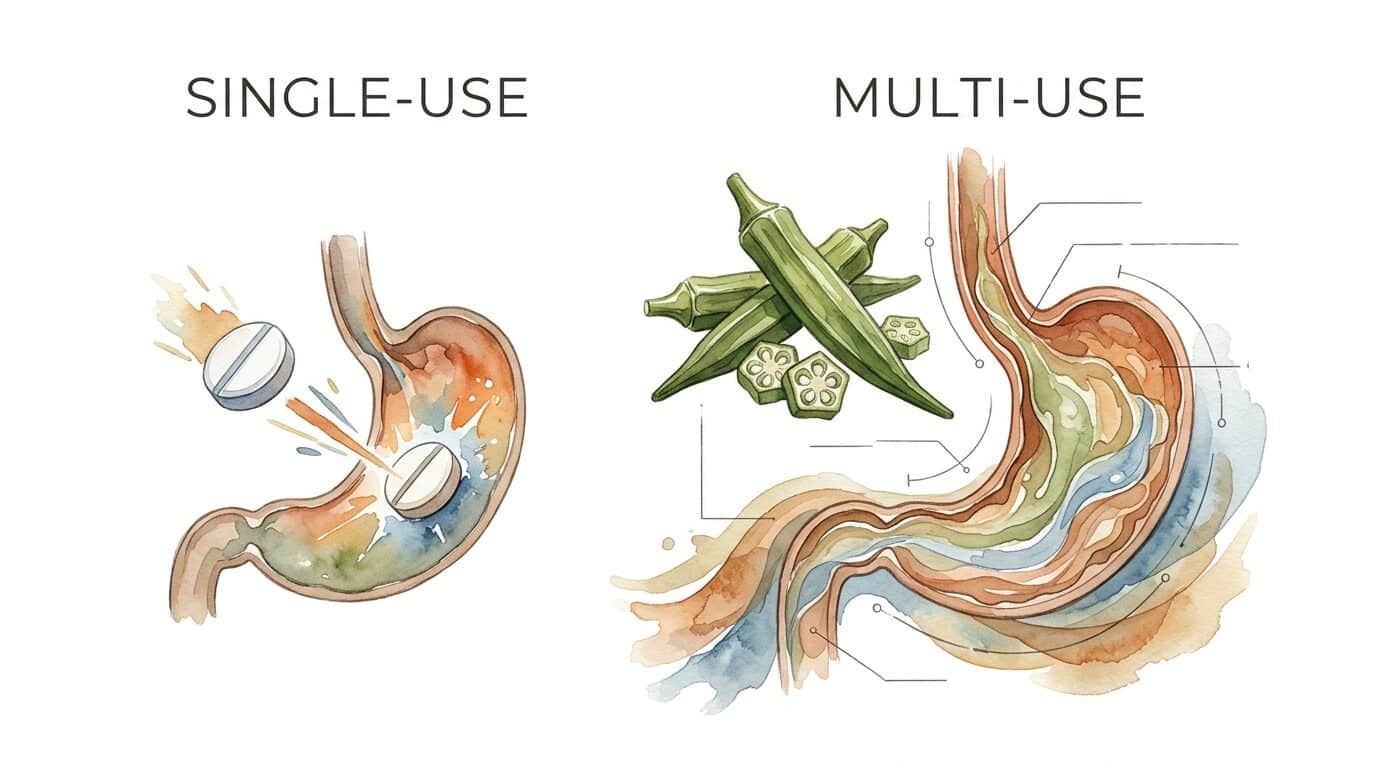
Why use a chemical barrier when nature provides a self-repairing, probiotic-feeding lubricant? Standard antacids do one thing: neutralize acid. Okra mucilage does three: it creates a physical ‘raft’ to block acid, lubricates the esophageal path, and acts as a prebiotic for the bacteria that actually prevent reflux in the first place.
Many people spend years chasing relief through chalky tablets and purple pills. These methods often provide a temporary truce but never actually win the war. They treat the stomach like a simple vat of acid that needs to be silenced, rather than a complex ecosystem that needs to be supported. Nature has a different approach, one that involves a humble, green pod that has been a staple in traditional kitchens for centuries.
If you are tired of the constant burn and the feeling that your own digestion is your enemy, it is time to look at the mechanics of your gut. We are going to explore how a simple vegetable can outperform synthetic chemicals by working with your body’s biology. This is not about a quick fix; it is about using a sturdy, reliable tool from the earth to restore balance to your digestive tract.
Okra For Acid Reflux Relief
Okra, or *Abelmoschus esculentus*, is often misunderstood because of its unique texture. That slippery, viscous substance found inside the pod is known as mucilage. While many modern cooks try to eliminate this “slime,” it is actually the most valuable part of the plant for anyone suffering from digestive distress. This mucilage is a complex mixture of polysaccharides and proteins that serves a vital purpose for the plant, and a medicinal one for the human body.
In the context of acid reflux, okra acts as a biological sealant. When you consume it, the mucilage coats the lining of the esophagus and the stomach. This provides a physical layer of protection against the harsh effects of gastric acid. Think of it as a natural liquid bandage that covers irritated tissue, allowing it to heal without being constantly agitated by the contents of your stomach.
This plant has been used in various cultures from West Africa to South Asia as a remedy for gastritis, ulcers, and general “heat” in the digestive system. It exists in the real world as a food-medicine hybrid. It is not just a bunch of vitamins; it is a mechanical solution to a mechanical problem. When your esophageal sphincter fails to keep acid down, the mucilage stands in the gap to minimize the damage.
How Okra Works to Quell the Fire
The mechanics of okra are fascinating once you dig into the chemistry. The mucilage consists of highly branched molecules that have a high affinity for water. When these molecules enter the acidic environment of the stomach, they do not just dissolve and disappear. Instead, they form a gel-like structure that is resistant to being broken down immediately by digestive enzymes.
One of the primary ways it helps is by creating what is known as a “raft.” In the world of reflux remedies, a raft is a layer that floats on top of the stomach contents. When the stomach contracts or when you lie down, this raft is the first thing to enter the esophagus. Because okra mucilage is alkaline and soothing, it neutralizes the immediate threat of acid splashback and leaves a protective film behind.
Beyond the physical coating, okra is a powerful prebiotic. Reflux is often exacerbated by an imbalance in gut flora, particularly an overgrowth of bacteria that produce gas and cause bloating. This upward pressure from gas forces the lower esophageal sphincter (LES) to open when it should stay closed. The fibers in okra feed the beneficial bacteria in the lower gut, helping to reduce the fermentation and pressure that cause reflux in the first place.
The Role of Polysaccharides
The specific polysaccharides in okra are unique. They are thick enough to provide a barrier but slippery enough to aid in the movement of food. This dual action ensures that food does not sit in the stomach for too long, which is a common trigger for reflux. If the stomach empties efficiently, there is less opportunity for acid to back up.
Mechanical Lubrication
Standard treatments focus on stopping acid production, but the body needs acid to digest protein and absorb minerals. Okra does not stop the acid; it manages it. By lubricating the entire path from the throat to the small intestine, it reduces the friction and irritation that often lead to chronic inflammation.
The Benefits of Using a Natural Mucilage
Choosing a natural mucilage like okra over a synthetic antacid offers several measurable advantages. Most over-the-counter remedies are “single-use” in their logic; they do one job and then leave the system, often leaving behind a chemical residue or causing “rebound” acid production. Okra is a “multi-use” tool that nourishes the body while solving the immediate problem.
The first benefit is the lack of side effects. Synthetic proton pump inhibitors (PPIs) have been linked to bone density loss and nutrient malabsorption because they shut down the stomach’s ability to process calcium and B12. Okra, being a whole food, contains calcium, potassium, and vitamin C. You are not sacrificing your long-term health for short-term comfort.
Another advantage is the cost and accessibility. Okra is an inexpensive vegetable that can be grown in many climates or bought at any local market. It does not require a prescription, and it does not come with a list of warnings in fine print. It is a sustainable way to manage a chronic condition without becoming dependent on a pharmaceutical supply chain.
* Coats the esophagus: Provides immediate relief from the “burn” of reflux.
* Supports the gut lining: Helps heal the mucosal layer of the stomach.
* Regulates blood sugar: Stable blood sugar levels can reduce the stress response that triggers reflux.
* Promotes regular bowel movements: Reduces the abdominal pressure that contributes to GERD.
Challenges and Common Preparation Mistakes
The biggest challenge people face with okra is the texture. The very thing that makes it effective—the sliminess—is what makes it unpalatable for some. Many people make the mistake of overcooking it in a way that turns the mucilage into a stringy, unappealing mess, or they fry it in heavy oils that actually trigger more reflux.
Another common pitfall is inconsistency. You cannot eat three pods of okra and expect your chronic GERD to vanish forever. This is a lifestyle adjustment. It requires regular consumption to maintain that protective layer in the digestive tract. Some people try it once, don’t like the taste, and give up before the biological benefits can take root.
Sourcing is also a factor. Frozen okra is often sliced, which causes much of the mucilage to leak out and get lost in the ice crystals. For the best results, you need fresh, firm pods. If the okra is old and woody, it will be difficult to chew and won’t release the same high-quality gel.
Limitations: When This May Not Be Ideal
While okra is a powerful ally, it is not a magic wand for every situation. There are realistic constraints to its effectiveness. For instance, if a person has a significant hiatal hernia—where a portion of the stomach has physically moved above the diaphragm—okra will provide soothing relief, but it will not fix the structural displacement. In such cases, mechanical issues may require medical intervention.
Another limitation involves people with a history of kidney stones. Okra is high in oxalates. If your body is prone to forming calcium-oxalate stones, you should consume okra in moderation and consult with a professional. It is also not a substitute for emergency care if you are experiencing severe chest pain that could be mistaken for reflux but is actually a cardiac event.
Environmental limitations also exist. In some regions, fresh okra is only available seasonally. While dried okra powder can be used as a substitute, it may not have the same immediate “raft-forming” capability as fresh mucilage. You must understand the boundaries of what a food-based remedy can achieve compared to surgical or intensive medical treatments for advanced diseases like Barrett’s esophagus.
Antacids vs. Okra: A Practical Comparison
It is helpful to compare the standard approach to the okra approach. Most people reach for an antacid because it is fast. However, we should look at the efficiency and long-term impact of these choices.
| Feature | Standard Antacids | Okra Mucilage |
|---|---|---|
| Primary Action | Neutralizes or stops acid | Coats and protects tissue |
| Nutritional Value | None (often hinders absorption) | High (Vitamins, minerals, fiber) |
| Gut Microbiome | Can cause imbalance (SIBO) | Acts as a prebiotic |
| Long-term Safety | Potential for rebound and bone loss | Safe for daily long-term use |
| Cost | Moderate (recurring cost) | Low (grocery staple) |
As the table shows, while an antacid might win on the speed of neutralizing a single meal, okra wins on the complexity of healing the system. It addresses the environment of the stomach rather than just the chemistry of the moment.
Practical Tips for Incorporating Okra
To get the most out of this plant, you need to know how to prepare it specifically for medicinal use. The goal is to maximize the release of mucilage without making the food difficult to eat.
One of the best methods is making “Okra Water.” This involves taking three to four fresh okra pods, slicing them down the middle, and soaking them in a glass of room-temperature water overnight. In the morning, remove the pods and drink the water. The water will be thick and slightly viscous. This provides a concentrated dose of mucilage on an empty stomach, which is the best time to coat the esophagus before you begin your daily meals.
If you prefer to eat the vegetable, try steaming it whole. By keeping the pod intact, you trap the mucilage inside. Once it is soft, you can eat it as a side dish. Avoid deep-frying, as the trans fats in frying oils are major triggers for the LES to relax, which will negate all the benefits of the okra itself.
* Time your intake: Drink okra water 20 minutes before a meal to prep the stomach.
* Pair with ginger: Ginger also helps with stomach emptying, making the two a powerful duo.
* Consistency is key: Try to include okra in your diet at least four times a week for chronic relief.
* Choose the right pods: Small, bright green pods are more tender and have better mucilage quality than large, dull ones.
Advanced Considerations for the Serious Practitioner
For those who want to go deeper into using food as medicine, consider the soil quality where your okra is grown. Plants grown in mineral-rich soil will produce more robust phytonutrients. If you have the space, growing okra yourself is a great way to ensure you are getting the freshest pods possible. It is a hardy plant that thrives in heat and requires very little maintenance.
Another advanced tip involves the “lectin” discussion. Some people are sensitive to lectins found in the skins and seeds of nightshades and legumes. While okra is not a nightshade, it does contain some lectins. If you find that you have a systemic inflammatory response to lectins, you might focus on the “Okra Water” method rather than consuming the seeds and skin, as the mucilage itself is the primary therapeutic agent and contains fewer of these proteins.
Consider the scaling of this remedy. If you are dealing with severe, long-term GERD, you might need to use okra in conjunction with other mucosal healers like Slippery Elm or Marshmallow Root. These plants work on similar principles, but okra has the added benefit of being a culinary staple that provides vitamins and minerals that the powdered barks do not.
Example Scenario: From Pills to Pods
Consider the case of a person who has relied on over-the-counter antacids for five years. Every time they eat a heavy meal or drink coffee, the burn returns within thirty minutes. They have tried increasing the dosage of their pills, but they are starting to experience sluggish digestion and bloating.
They decide to try the okra protocol. Every night, they prepare a glass of okra water. Every morning, they drink it first thing. Within the first week, they notice that the “edge” is taken off the reflux. It isn’t gone, but the intensity is lower. After three weeks of consistent okra water and adding steamed okra to their dinners, they find they only need an antacid once a week instead of every day.
By the second month, the prebiotic effect of the okra fiber has reduced their bloating. The lower abdominal pressure has allowed their LES to function more effectively. This is the difference between treating a symptom and supporting a system. They didn’t just neutralize acid; they repaired the environment that was letting the acid escape.
Final Thoughts
Healing the gut is not about forcing it into submission with chemicals. It is about understanding the simple, mechanical needs of our internal lining and providing the right materials for repair. Okra is a perfect example of a traditional solution that stands up to modern scrutiny. It is affordable, effective, and works in harmony with your body’s natural processes.
The mucilage in okra provides a protective shield, a digestive lubricant, and a food source for beneficial bacteria. This triple-action approach makes it far superior to any single-use chemical fix. It requires a shift in perspective—viewing the “slime” not as a culinary defect, but as a biological gift.
I encourage you to experiment with this remedy. Start with the okra water or a simple steamed dish. Watch how your body responds over a few weeks. You may find that the answer to your chronic discomfort was growing in the garden all along, waiting for you to recognize its sturdy, pioneer-grit value. Apply this knowledge with consistency, and let nature do the heavy lifting for your health.