Turn your sensitive stomach into a fortress with this ancient architectural starch. Heartburn isn’t just about the acid; it’s about a fragile lining that can’t handle the heat. Kudzu root starch acts like biological rebar, thickening the protective mucosal barrier and creating a resilient environment that acid can’t touch.
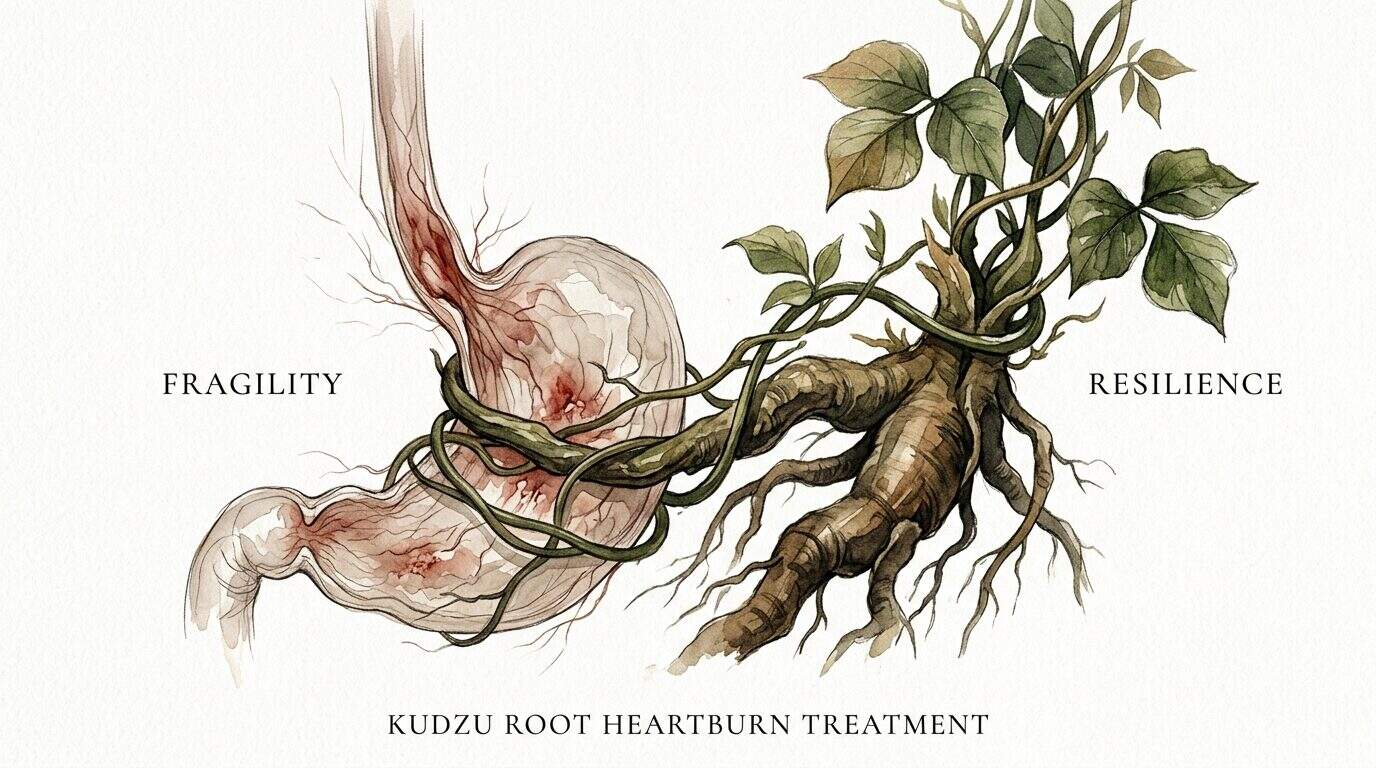
If you have ever felt that searing heat climbing up your throat after a meal, you know the desperation for relief. Most people reach for a chalky tablet or a pill that shuts down acid production entirely. While these might offer a temporary truce, they often leave the underlying territory undefended. You are essentially turning off the fire alarm while the walls are still smoldering.
True digestive fortitude comes from strengthening the structure of the gut itself. In the world of traditional medicine, few substances offer the structural integrity of the kudzu root. This isn’t just a plant; it is a deep-reaching, persistent vine that holds the earth together. When processed into a fine starch, it does the same for your internal lining. This guide will walk you through how to use this hardy botanical to move from a state of fragile irritation to resilient digestive health.
Kudzu Root Heartburn Treatment
Kudzu root heartburn treatment is a method of using the powdered starch of the Pueraria lobata plant to soothe and protect the upper gastrointestinal tract. In traditional Chinese and Japanese medicine, kudzu has been a staple for centuries, valued for its “cooling” properties and its ability to settle the “middle burner” or the stomach area. It is more than a simple food additive; it is a functional starch that behaves differently than corn or wheat flour.
The root itself is a powerhouse of complex carbohydrates and unique phytochemicals. To get the medicinal benefits, the woody, massive roots are crushed, washed, and filtered to extract the pure starch. This starch is then dried into chalky white chunks. When you use kudzu for heartburn, you are essentially creating a biological “plaster” that coats the esophagus and stomach lining. This coating acts as a physical buffer, preventing stomach acid from making direct contact with sensitive or eroded tissues.
Imagine a wooden fence that has been battered by the sun and rain until the grain is raw and exposed. If you pour acid on that raw wood, it chars immediately. However, if you apply a thick, protective layer of sealant first, the wood remains untouched. Kudzu provides that sealant for your mucosal lining. It is used in real-world situations ranging from acute acid reflux episodes to the management of chronic gastritis and even recovery from stomach flus. It is a tool for those who want to build a more resilient digestive system rather than just masking symptoms.
How to Prepare and Use Kudzu for Relief
Using kudzu root for medicinal purposes requires a specific preparation method to activate its thickening properties. You cannot simply swallow the powder dry or mix it into cold water and expect it to work. The starch must be gelatinized through heat to create the demulcent (soothing) effect that heals the gut.
The most common preparation is a simple medicinal “pudding” or tea known in Japan as Kuzu-yu. To start, take about one tablespoon of high-quality kudzu starch chunks. Place them in a small saucepan and add a few tablespoons of cold water. Use a spoon to crush the chunks and stir until you have a smooth, milky slurry. This cold-start is vital; if you add hot water directly to the dry starch, it will clump and ruin the texture.
Once the slurry is smooth, add about one cup of room-temperature water. Place the pan over medium-low heat and stir constantly. As the liquid heats up, it will transition from an opaque white to a translucent, semi-clear grey or amber color. The texture will thicken into a smooth, slightly viscous syrup. This is the moment the kudzu becomes biologically active. Remove it from the heat immediately to avoid overcooking, which can break down the starch chains.
For those dealing with intense heartburn, sipping this warm mixture slowly is the best approach. The viscosity allows the liquid to cling to the walls of the esophagus as it travels down. This provides immediate mechanical relief. Many practitioners recommend adding a small amount of crushed Umeboshi plum (salted plum) to the mixture. This addition helps to further alkalize the digestive tract and provides a synergistic effect that settles the stomach even faster.
The Importance of Timing
Timing is a critical component of the treatment. For chronic sufferers, taking kudzu on an empty stomach—usually first thing in the morning or 30 minutes before a meal—creates a protective “pre-coat.” This ensures that when the stomach begins to produce acid for digestion, the lining is already fortified. If you are using it for acute relief, take it as soon as you feel the first signs of discomfort. Unlike chemical antacids that work by neutralizing the acid already present, kudzu works by protecting the tissue from the acid’s presence.
Mixing with Other Agents
While water is the standard base, you can enhance the healing properties of kudzu by using herbal infusions. Using a cooled ginger tea as the base liquid can help if your heartburn is accompanied by nausea or slow motility. If you have severe inflammation, a marshmallow root or slippery elm infusion can be used alongside the kudzu to create a “super-demulcent” that provides an even thicker barrier for the stomach wall. This layered approach is how you move from fragile temporary relief to a resilient, long-term solution.
Benefits of Kudzu for Digestive Health
The primary benefit of kudzu root is its incredible demulcent property. A demulcent is a substance that forms a soothing film over a mucous membrane. In the context of heartburn, this means the raw, irritated tissue of the esophagus is given a chance to rest and heal. When the tissue isn’t constantly being “burned” by acid, the body’s natural regenerative processes can take over. This is the difference between surviving a digestive flare-up and actually recovering from one.
Beyond the physical coating, kudzu contains high concentrations of isoflavones, specifically one called puerarin. Puerarin has been studied for its ability to improve blood flow and reduce inflammation. In the gut, this translates to better microcirculation in the stomach lining. Better blood flow means faster delivery of nutrients to damaged cells and more efficient removal of waste products. This “pioneer-grit” approach to healing focuses on the underlying infrastructure of the body.
- Alkalizing Effect: Despite being a starch, kudzu has an alkalizing effect on the body’s internal environment, helping to balance the acidic nature of a modern diet.
- Anti-Spasmodic Properties: Kudzu helps relax the smooth muscles of the digestive tract, which can prevent the “back-pumping” of acid caused by stomach spasms or hiatal hernia tension.
- Alcohol Cravings and Gut Repair: Kudzu has a long history of use in reducing alcohol cravings. Since alcohol is a primary irritant that thins the stomach lining, kudzu offers a double benefit: it reduces the desire for the irritant while repairing the damage the irritant caused.
- Prebiotic Support: The complex starches in kudzu act as a food source for beneficial gut bacteria. A healthy microbiome is essential for maintaining the integrity of the mucosal barrier over the long term.
Choosing kudzu over modern alternatives often comes down to the desire for a “clean” intervention. Most over-the-counter antacids contain aluminum, magnesium salts, or artificial sweeteners. Kudzu is a single-ingredient, whole-food product. It doesn’t interfere with the body’s ability to produce acid—which is necessary for protein digestion and mineral absorption—but rather changes how the body handles that acid. This makes it a far more sustainable choice for those who value long-term health over a quick, chemically-induced fix.
Challenges and Common Mistakes
The most frequent pitfall when using kudzu is sourcing the wrong product. In many grocery stores, you will find “kudzu” that is actually a blend of potato starch or arrowroot. While these are fine for thickening a gravy, they lack the specific medicinal isoflavones found in pure Pueraria lobata. True medicinal kudzu is usually found in health food stores or Asian markets, sold in solid, chalky white chunks rather than a fine, free-flowing powder. If the price seems too good to be true, it is likely not pure kudzu.
Another common mistake happens in the kitchen. Many people treat kudzu like cornstarch and try to whisk it into boiling water. This results in “fish eyes”—little translucent balls of raw starch that are slimy on the outside and dry on the inside. These are not only unpleasant to eat, but they also fail to provide the consistent coating needed to soothe the esophagus. You must respect the “cold-start” process to ensure the starch is fully hydrated before it is heated.
Consistency is also a challenge. Because kudzu is a natural remedy, it doesn’t always provide the “instant” numbing sensation that some liquid antacids offer. Some users give up after one try, thinking it didn’t work. However, the healing of the mucosal lining is a cumulative process. It takes time to rebuild the “biological rebar” that kudzu provides. Impatience is the enemy of resilience in this case.
Finally, some people over-sweeten their kudzu mixture. While the taste of plain kudzu is mild and slightly nutty, adding large amounts of refined sugar or honey can actually trigger more acid production in some individuals. This creates a “one step forward, two steps back” scenario. If you need flavor, a drop of maple syrup or the traditional Umeboshi plum is a much better choice that won’t compromise the medicinal goals of the treatment.
Limitations and When Kudzu May Not Be Ideal
While kudzu is a powerful ally, it is not a magic wand for every situation. There are realistic constraints to its use. For instance, kudzu contains phytoestrogens. While these are generally much weaker than human estrogen, individuals with estrogen-sensitive conditions (such as certain types of breast or uterine cancers) should consult with a healthcare professional before using kudzu in large medicinal quantities. The concentration of isoflavones is high enough that it could potentially interfere with hormonal balances in sensitive individuals.
Environmental trade-offs are also a factor. Kudzu is an invasive species in many parts of the world, particularly the Southern United States. While this makes it abundant, you cannot simply go out to the side of the road and dig up a root to eat. Kudzu roots absorb heavy metals and pollutants from the soil with high efficiency. Unless you are harvesting from a known, pristine environment and have the heavy-duty machinery required to process the woody roots, you are better off buying laboratory-tested starch from reputable sources.
Practical boundaries also exist for those on blood-thinning medications. Puerarin can have a mild anti-platelet effect, meaning it may slow blood clotting. If you are scheduled for surgery or are taking medications like Warfarin or Aspirin daily, you need to be cautious. The goal is to build a resilient gut, not to create a different problem in your circulatory system. Always look at the body as an interconnected system rather than a series of isolated parts.
Furthermore, kudzu is a “cooling” herb in traditional medicine. For someone who already has a “cold” constitution—characterized by very slow digestion, a pale tongue, and a constant feeling of being cold—using kudzu every day might dampen their “digestive fire” too much. In these cases, it is essential to balance the kudzu with “warming” agents like fresh ginger or cinnamon to ensure that the stomach can still break down food effectively.
Comparing Kudzu with Other Common Starches
When looking at ways to thicken a medicinal tea or coat the stomach, you might wonder why kudzu is preferred over cheaper options like cornstarch or arrowroot. The following table highlights the measurable differences between these common starches in a medicinal context.
| Feature | Kudzu Starch | Cornstarch | Arrowroot Starch |
|---|---|---|---|
| Medicinal Compounds | High (Isoflavones/Puerarin) | None | Minimal |
| Effect on Digestion | Alkalizing / Soothing | Acidifying / Neutral | Neutral / Soothing |
| Viscosity Retention | High (remains thick in stomach) | Medium (breaks down quickly) | Low (thins out easily) |
| Traditional Use | Extensive (Digestive/Circulatory) | None (Culinary only) | Mild (Digestive) |
| Processing Method | Labor-intensive (Traditional) | Industrial / Chemical | Natural / Mechanical |
As the table demonstrates, kudzu is the “resilient” choice. Cornstarch is a “fragile” solution; it provides a temporary thickness that the enzymes in your saliva and stomach acid break down almost immediately. Kudzu, however, maintains its structural integrity longer, allowing it to provide a persistent shield for the esophagus. While it is more expensive and requires more effort to find, the efficiency and biological benefits make it the superior tool for those serious about their gut health.
Practical Tips for Success
To get the most out of your kudzu root treatment, you need to apply it with precision. Here are some actionable tips that can help you optimize the process and see better results.
- Sourcing the Best: Look for “Wild Crafted” or “Traditional Japanese” kudzu. Brands like Mitoku or Eden Foods often provide the high-quality chunks that have been processed using cold mountain water and traditional filtering methods. Avoid anything labeled “Kudzu Powder” that is a fine, dusty consistency.
- The “Night Before” Preparation: If you find it hard to cook kudzu in the morning, you can make a thicker “kudzu jelly” the night before. Let it set in the fridge. In the morning, you can take a spoonful of the cold jelly. While not as soothing as the warm tea, it still provides the physical barrier.
- The Licking-the-Spoon Test: A properly prepared kudzu slurry should be clear and shiny. If it looks “milky” or “cloudy” after heating, you haven’t cooked it long enough to gelatinize the starch. Keep it on the heat for another 30 seconds while stirring.
- Storage: Keep your dry kudzu chunks in a glass jar in a cool, dark place. Because it is a pure starch with very little moisture, it has an incredibly long shelf life—often lasting several years without losing its medicinal potency.
- Monitor Your Progress: Keep a simple log of your symptoms. Notice if the frequency of your heartburn decreases or if the intensity of the “burn” is muffled. This feedback loop will help you decide if you need to adjust your dosage or timing.
The transition from a fragile gut to a resilient one is a journey of small, consistent actions. Using kudzu is one of those actions that pays dividends over time. It is about equipping your body with the raw materials it needs to defend itself.
Advanced Considerations for Serious Practitioners
For those who have mastered the basic kudzu tea and want to go deeper, there are advanced ways to integrate this root into a health regimen. One such method involves using kudzu as a carrier for other fat-soluble nutrients. While kudzu is a carbohydrate, the way it coats the intestines can actually assist in the steady absorption of other substances. For example, mixing a high-quality turmeric extract into your kudzu pudding can enhance the anti-inflammatory effects on the gut wall.
Another advanced technique involves “Layered Demulcents.” This is used for people with severe “Leaky Gut” or advanced Gastritis. You begin with a small dose of L-Glutamine (an amino acid that fuels gut cell repair) followed 10 minutes later by a thick kudzu preparation. The L-Glutamine provides the “fuel,” and the kudzu provides the “shelter” (the coating) that allows the cells to use that fuel without being interrupted by acid or food particles.
Scaling the use of kudzu is also important. In times of high stress—which we know can trigger acid production and thin the mucosal lining—you might increase your kudzu intake to three times a day. During times of maintenance and health, you might drop back to a single “fortifying” cup every few days. Being able to scale your intervention based on your environmental “load” is a hallmark of an advanced practitioner who understands the ebb and flow of their own biology.
Finally, consider the role of fermentation. Some traditional practitioners will mix kudzu with a small amount of miso paste. The enzymes in the miso begin to break down the kudzu starches into simpler sugars, making them even easier to digest while providing a dose of probiotics. This combination is particularly useful for those recovering from a round of antibiotics, which often leaves the stomach lining vulnerable and the microbiome depleted.
Scenario: The Chronic Reflux Case
Let’s look at how this works in a real-world scenario. Imagine a 45-year-old individual who has dealt with “fragile” digestion for a decade. They suffer from nighttime reflux that keeps them awake and have a constant “sour” taste in their mouth. They have used over-the-counter antacids for years, but the symptoms always return the moment they stop. Their stomach lining is chronically irritated.
By introducing a kudzu root protocol, the strategy changes from “attacking the acid” to “defending the tissue.” They start by taking one cup of Ume-Sho-Kuzu (kudzu with Umeboshi and a drop of soy sauce) every morning 30 minutes before coffee or breakfast. This creates that “biological rebar” we discussed earlier.
After the first week, they notice that the “sharpness” of their morning heartburn has dulled. By the third week, the nighttime reflux has diminished because the esophageal lining is no longer so raw that even a tiny amount of acid causes a massive pain response. By the second month, they find they no longer need the daily antacid tablets. The kudzu hasn’t “cured” the reflux, but it has made the digestive tract resilient enough to handle its own functions without pain. They have moved from a state of constant emergency to a state of structural stability.
In this example, the user didn’t just find a new “pill.” They adopted a ritual that strengthened their internal architecture. They used simple numbers—one tablespoon of starch, one cup of water—and a consistent step-by-step reasoning to reclaim their health. This is the power of using a plant that knows how to hold its ground.
Final Thoughts
Rebuilding a damaged digestive system requires patience and the right materials. Kudzu root starch offers a unique combination of physical protection and biochemical support that modern “quick-fix” solutions simply cannot match. By treating the stomach lining as an architectural feature that needs reinforcement rather than a nuisance that needs to be silenced, you can achieve a level of comfort that feels like a return to a more natural, sturdy state of being.
The journey from a fragile lining to a resilient one doesn’t happen overnight. It is the result of choosing tools that work in harmony with your body’s own healing mechanisms. Kudzu is a testament to the idea that sometimes the most aggressive “weeds” in nature provide the most profound stability for our health. It encourages us to look at the ground beneath our feet for the solutions to the fires within our chests.
I encourage you to experiment with this ancient starch. Start with the basic tea, observe how your body responds, and then refine your approach. Whether you are dealing with occasional heartburn or chronic irritation, kudzu can serve as the cornerstone of your digestive fortress. Once you experience the soothing, structural support it provides, you may find that you never want to go back to the fragile alternatives again. Keep exploring the world of functional foods and traditional wisdom; there is a wealth of grit and resilience waiting to be rediscovered.